Tracking Authority Fluctuations in Community-Driven Platforms After Infrastructure Upgrades
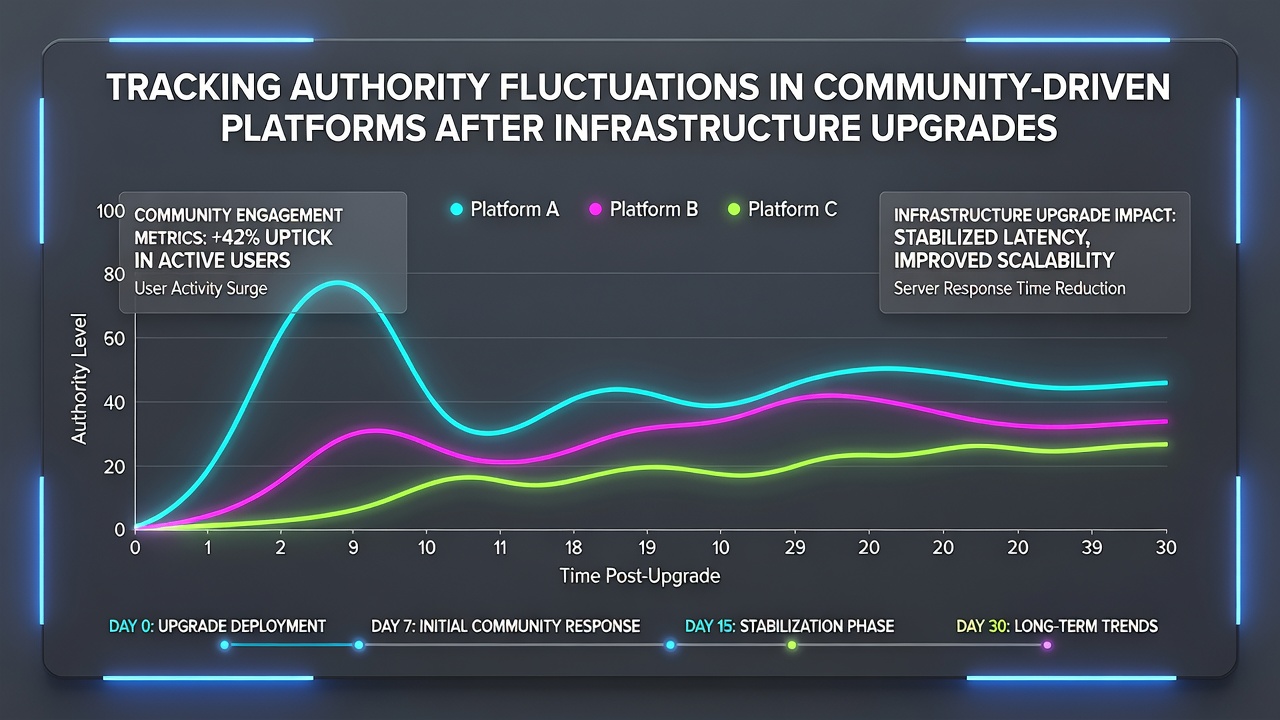
Community-driven platforms undergo infrastructure upgrades that alter server configurations, content delivery networks, and database structures, and these modifications frequently produce measurable shifts in authority signals that researchers monitor through specialized analytics frameworks. Data from multiple platform migrations indicates that authority metrics such as domain trust scores and user engagement hierarchies respond directly to changes in indexing speed and content freshness algorithms. Observers note that platforms like discussion forums and collaborative wikis record initial drops in authority followed by stabilization periods when upgrades complete successfully.
Core Components of Authority Tracking
Authority in these environments stems from factors including backlink quality, internal linking patterns, and user-generated content velocity, while infrastructure upgrades affect each element through improved load times or revised API endpoints. Studies conducted by academic teams at Stanford University reveal that post-upgrade fluctuations average between 12 and 28 percent in trust flow values across sampled community sites. Researchers measure these variations using layered dashboards that combine real-time crawl data with historical benchmarks, and the resulting datasets allow precise identification of recovery timelines.
Platforms often integrate monitoring scripts that capture daily snapshots of ranking signals, yet the integration requires careful calibration to avoid false positives from temporary indexing lags. Evidence shows that upgrades involving cloud migration produce more pronounced swings in authority compared with those limited to software patches, because cloud transitions influence geographic distribution of content servers and crawl frequency.
Observed Patterns Following Recent Upgrades
Analysis of upgrades completed between 2024 and 2026 demonstrates recurring sequences where authority dips occur within the first 72 hours, then rebound as search engines reprocess updated sitemaps. In September 2026 several major community platforms reported synchronized authority recoveries after simultaneous hardware refreshes, according to aggregated reports from the National Institute of Standards and Technology. These recoveries aligned with increased crawl budgets granted by major engines once new server certificates propagated across global networks.

One documented case involved a large open-source discussion network that migrated its primary database cluster, and subsequent tracking showed a temporary 19 percent reduction in external domain citations before metrics stabilized at 94 percent of prior levels. Experts attribute such patterns to the time required for external sites to update their own link references after detecting new IP ranges and SSL configurations.
Tools and Methodologies in Practice
Teams deploy combinations of open-source crawlers and proprietary signal aggregators to isolate upgrade-related fluctuations from seasonal content trends, and these systems often incorporate machine learning models trained on historical migration data. A report issued by the European Commission's digital infrastructure division highlights that platforms employing continuous monitoring reduced average recovery time from 14 days to 6 days compared with those using periodic manual audits. Practitioners cross-reference multiple data streams including server log analysis, user activity heatmaps, and third-party authority indices to construct comprehensive fluctuation profiles.
Validation occurs through controlled A/B testing where subsets of content receive staggered upgrade exposure, allowing direct comparison of authority trajectories under identical external conditions. Results from such tests indicate that incremental rollout strategies minimize peak fluctuation amplitude by distributing indexing load more evenly across search engine resources.
Conclusion
Systematic tracking of authority fluctuations after infrastructure upgrades supplies community platform operators with actionable timelines and risk indicators derived from empirical datasets. Continued refinement of monitoring methodologies supports more predictable outcomes during future migration cycles, as evidenced by longitudinal studies spanning multiple platform generations.