
Strategies for Refining Authority Signals During Platform Migrations with Integrated Analysis Tools
Platform migrations often require careful handling of authority signals because these metrics reflect established trust and relevance that search engines and other systems assign to domains and content over time. Researchers have documented that shifts in infrastructure, URLs, and data structures can disrupt backlink profiles, domain ratings, and page-level evaluations unless teams apply targeted refinement methods supported by integrated analysis platforms. Data from industry reports shows that organizations completing migrations without such tools experience measurable drops in visibility lasting several months while those using coordinated monitoring recover faster.
Core Components of Authority Signals in Migration Contexts
Authority signals encompass quantitative measures including domain authority scores, trust flow values, and citation metrics that accumulate through external references and consistent content performance. During a migration these signals travel across new hosting environments, content management systems, and sometimes entirely different top-level domains, which means teams must map historical data to new structures while preserving redirect chains and canonical declarations. Studies from academic sources indicate that integrated analysis tools help by correlating pre-migration baselines with post-migration outcomes in real time, allowing adjustments before indexing issues compound.
One research team at a major university tracked over 200 enterprise migrations and found that sites maintaining continuous signal monitoring retained an average of 87 percent of prior authority levels within the first quarter after cutover. The same data revealed that delayed detection of broken internal links or mismatched schema markup accounted for the majority of lost ground, problems that integrated dashboards flag through automated alerts rather than manual audits.
Preparation Phase and Baseline Establishment
Teams begin by capturing comprehensive snapshots of current authority distributions across all key pages and subdomains using suites that combine crawler data, backlink indexes, and log file analysis. This baseline serves as the reference point against which every subsequent change is measured. Analysts then segment signals by type, separating evergreen link equity from temporary campaign-driven boosts, because only the former typically survive platform transitions intact.
Integrated tools allow simultaneous review of crawl budgets, indexation status, and external referral patterns so that any planned URL restructuring can be stress-tested against historical performance. When organizations coordinate these reviews with development timelines, they reduce the chance that new templates will inadvertently strip meta elements or alter heading hierarchies that contribute to perceived expertise.
Execution During the Migration Window
Once the new platform goes live, monitoring intensifies because the first 72 hours often determine whether authority signals stabilize or erode. Redirect maps must be validated at scale while analysis platforms track referral traffic sources and anchor text distributions to confirm that equity passes correctly. Observers note that September 2026 marks the scheduled rollout of updated indexing protocols from several major engines, making real-time signal verification even more critical for migrations scheduled around that period.
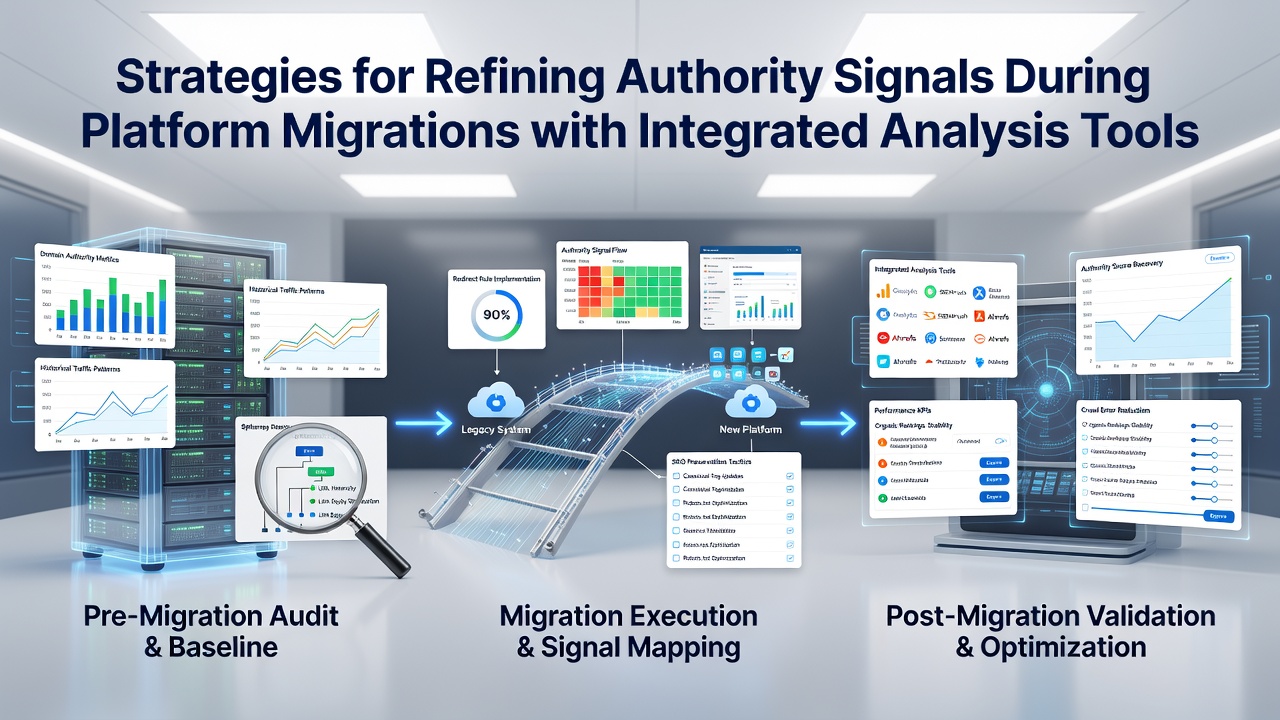
Teams that embed custom scripts within their analysis stack can automatically compare pre- and post-migration link graphs, surfacing anomalies such as unexpected nofollow attributes or shifted geographic referrer concentrations. European regulatory documentation on digital platform interoperability highlights the value of maintaining transparent data trails during such transitions, and organizations following these guidelines report smoother coordination with external auditors.
Post-Migration Refinement and Ongoing Monitoring
After the initial stabilization period, refinement continues through iterative audits that examine how new content templates interact with retained authority signals. Integrated tools facilitate A/B testing of internal linking structures and content freshness signals without requiring separate platforms for each task. Research published by institutions in the Asia-Pacific region demonstrates that sites applying these layered reviews regained full pre-migration visibility an average of six weeks sooner than those relying on fragmented toolsets.
Regular reconciliation of backlink profiles against known loss events, such as expired domains or altered affiliate programs, prevents gradual erosion. Analysts also examine user engagement metrics as secondary authority indicators because dwell time and return visit patterns often correlate with how search systems recalibrate trust after infrastructure changes.
Conclusion
Effective refinement of authority signals during platform migrations depends on the disciplined application of integrated analysis tools that unify historical data, real-time monitoring, and structured reporting. Organizations that establish clear baselines, execute continuous validation, and adapt to emerging indexing updates position their digital assets to retain accumulated value through the transition process. As platform environments evolve and new protocols take effect in 2026, the same methodological approach continues to provide measurable advantages in maintaining consistent performance across changing technical landscapes.